
Baseball in Japan: Catching a Game in Osaka & Exploring the City

Updated: Dec 28, 2025

As I mentioned in previous posts, our 2025 trip to Japan was our third visit to the country. On our first trip, I did a day trip to Osaka, taking the bullet train from Kyoto while Teresa was busy with her Ikebana course. On our second visit, we stayed in Osaka during plum blossom season. The plum blossoms are almost as beautiful as cherry blossoms—and much less crowded. That time, we also used Osaka as a base for day trips to Kobe and Hiroshima.
During that earlier stay, we joined a walking tour with Osaka Free Walking Tour (it isn’t really “free”—you don’t pay a set fee, but tipping is expected, as that’s how the guides make a living). Our guide was fantastic and gave us a great introduction to the city, complete with a solid sense of humour. One thing he emphasized was that Osaka is Japan’s “fun, party city.” According to him, locals aren’t as stuck-up as those in Kyoto (his words, not mine), and Osaka doesn’t mind a little grit on its streets. It’s a lively, energetic city with tons to do. You can read my blog post about that first visit here.
When I started planning this trip, Osaka wasn’t originally on our list. But while researching, I realized that the 2025 World’s Fair was being held there. Expo 2025 Osaka-Kansai ran from April 13 to October 13, 2025, under the theme “Designing Future Society for Our Lives.” The Expo took place on Yumeshima Island and featured a massive wooden “Grand Ring,” along with pavilions from more than 150 countries, international organizations, and companies. In total, over 29 million people visited.
We certainly wouldn’t have travelled to Japan just for the World’s Fair, but since we were already there during the Expo, it felt like something we shouldn’t miss. Teresa and I were living in Vancouver during Expo 86, had season passes, and absolutely loved it, so this felt a bit nostalgic.
Once our dates and accommodations were booked, I started looking into something else high on my list: Japanese baseball. It’s been a long-time goal of mine, and Osaka felt like the perfect place to finally make it happen. As a bonus, my sister Lynn and her husband Murray were cruising around Japan and had added a few days at the end of their trip. The timing worked out perfectly for us to meet in Osaka, explore the city, and attend a baseball game together. Everything was lining up nicely.
As with my other posts, I’ll list all the accommodations, restaurants, and services we used at the end for reference.
Teresa and I spent our first two days in Osaka at the World’s Fair. I won’t go into too much detail, since it’s now over, but part of the Grand Ring will remain, and the site will be redeveloped into a mixed-use park, recreation, and commercial area. Given how well Japan handles these projects, it’s almost guaranteed to be worth a future visit.
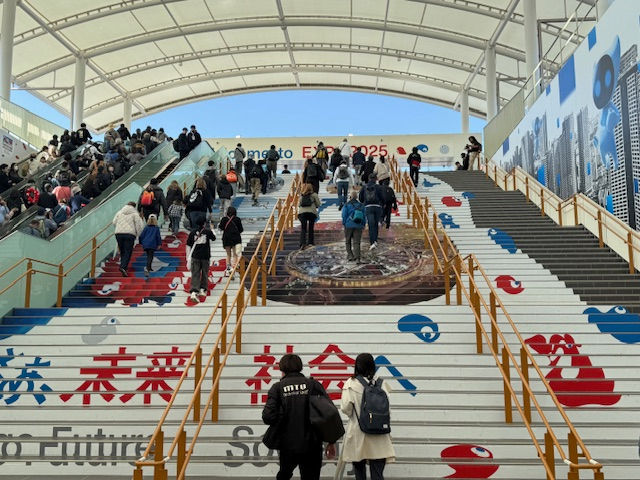

One thing that is worth mentioning is the public transit to the Expo site. Public transit in Japan is incredible, and the subway systems in particular are extensive, clean, and always on time. Pro tip: You can load a Suica card directly into your Apple Wallet, add money, and simply tap in and out. This saves you from massive lineups for single-use tickets or reloading physical cards.
Yumeshima Island itself is a huge man-made island built from reclaimed land. The new subway station there is massive, ultra-efficient, and feels almost space-age. Every time we passed through it, it felt like part of the experience. As you exit the station, you’re greeted by views of the Expo entrance and the Grand Ring—pretty impressive. Entry and exit were smooth and efficient, and at the end of the day, staff even waved goodbye and thanked visitors for coming. A small but very Japanese touch. Even though the Expo has ended, you can still visit their website here.


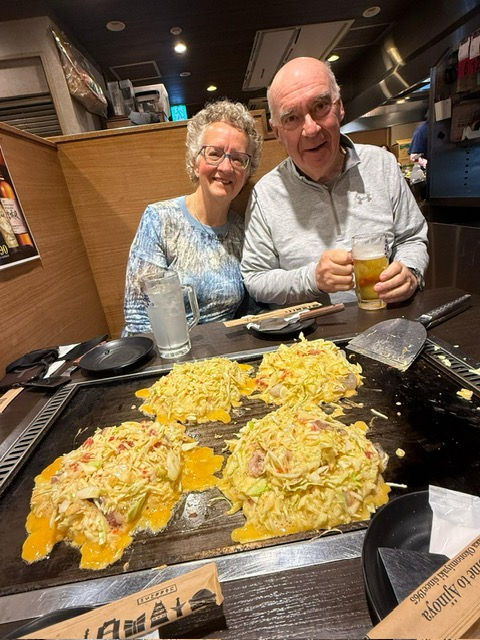
The following day, we met up with Lynn and Murray for an early dinner at Ajinoya, my favourite okonomiyaki restaurant. Okonomiyaki is often described as a Japanese savoury pancake or “as-you-like-it” dish. The name comes from okonomi (“what you like”) and yaki (“grilled”). The base is a batter made from flour, egg, shredded cabbage, and sometimes grated yams for extra fluffiness, with toppings like pork, shrimp, squid, or octopus. It’s finished with a sweet-savoury sauce similar to Worcestershire. There are regional variations—Hiroshima-style is very different—but the Osaka-style okonomiyaki at Ajinoya is still my favourite.
After dinner, we headed to TeamLab Osaka. TeamLab is an immersive digital art experience that’s extremely popular in Japan, with over 25 locations across the country. The Osaka version is outdoors, which makes it a bit different. That said, I’d personally put TeamLab in the “slightly overrated” category. In both Osaka and Tokyo, I found that the experience eventually felt repetitive. It’s visually interesting and definitely different, but if your time is limited, I’d rank it lower on your must-see list.


The next day was our final visit to the Expo. Two days would probably have been enough, but the third day was more relaxed and gave us time to walk the Grand Ring (which is amazing) and visit pavilions we had missed earlier. While researching the Expo, I discovered that some people actually travel the world attending these events. That won’t be us, but we were definitely glad we experienced the Osaka Expo.


Our last full day in Japan was packed: a walking tour of Osaka followed by baseball. We started with breakfast at Micasadeco & Cafe, a place Teresa and I stumbled upon during our first trip. The star of the menu is their fluffy Japanese pancakes. If you’ve never had them, this is the place. We’ve tried similar pancakes in Toronto and even in Seoul, but nothing compares. Pair them with great coffee and you’re set. Get there early—there’s always a lineup. My recommendation: the fluffy pancake with ricotta. Absolutely worth it.
After breakfast, we set out on a self-guided walking tour that took us through the Kita area, Grand Front Osaka, Hankyu Department Store, Whity Umeda, and the Hanshin Tigers official store (to make sure we were properly outfitted for the game). We also walked Tenjinbashisuji Shotengai, visited Osaka Tenmangu Shrine, wandered through Shinsaibashi-suji, and ended in Dotonbori. It was a lot of walking, but the best way to experience the city. Walking lets you stumble upon places you didn’t even know you were looking for.
My favourite Japan travel site is Inside Kyoto—I honestly think you could plan an entire Kyoto trip using just that site. Their sister site, Inside Osaka, was a huge help in planning our walking route.
After a short rest, it was time for the highlight of the day: our first-ever Japanese baseball game. I can say right now—it didn’t disappoint. In fact, it exceeded every expectation.
A few things to know if you’re planning to attend a Japanese baseball game:
First, it’s incredibly popular. Games are often sold out, especially in major cities like Osaka and Tokyo, so plan well in advance. Second, teams are named after their owners, not their cities. Osaka’s team is the Hanshin Tigers—Hanshin being the department store chain that owns them. It still feels strange to me, like calling the Jays the “Rogers Blue Jays.” Yuck!
Third, buying tickets through official team websites is very difficult. Even when an English option exists, you often hit Japanese-only pages during checkout.
I found it much easier to use a site called Chiketto. If tickets aren’t on sale yet, you can submit a request, and they’ll try to match your preferences. If tickets are available, they list them directly. Their service fees are reasonable, and we ended up with great seats in both Osaka and Tokyo. Seating matters. Stadiums usually have sections for home fans, visiting fans, and sometimes mixed sections. If possible, I recommend sitting with the home fans. We were in a mixed section in Osaka (which was still fun) and a home section in Tokyo.
Arrive early. The gates opened at 4:00 p.m. for a 6:00 p.m. game, and there were already lineups for both entry and the souvenir shop. They sell draft beer in the stands—served by an all-female team carrying kegs on their backs. Yet another reason to love Japanese baseball. Don’t eat beforehand. Stadium food is varied, delicious, and reasonably priced (unlike at Rogers Centre). Finally, you’re expected to take your garbage with you when you leave. Everyone does, and the stadium is remarkably clean afterward. It’s such a simple, great system.
Once inside, we had a bit of trouble finding our seats—Japanese tickets aren’t exactly intuitive if you can’t read them—but the attendants happily walked us right to our row. We grabbed our first in-stadium draft beer, a special version of Asahi only available at the Osaka stadium, and stuck with it all game. At about $8 Canadian, it felt like a steal compared to North American prices.


The atmosphere was incredible. Japanese players take warm-ups and practice very seriously—stretching is practically a workout, and infield drills are intense. Once the game started, the cheering never stopped. Bands played throughout the game, and the crowd was fully engaged from first pitch to final out. Businesspeople arrived in suits, changed into jerseys, and settled in. There were also plenty of women attending alone, all ages, equally invested in the game.
Unlike many games back home, where people drift in late and leave early, the fans in Osaka were there to watch baseball. And it showed. The experience was everything I hoped for and more—and it only made us more excited for the game we had coming up in Tokyo.
That wraps up our 2025 visit to Osaka. What a city. If you have any questions or comments, feel free to contact me at thethirdperiod.ca@gmail.com.
Links to related posts:
Japan 2020
India and Japan - 2025
Exploring India and Japan: Highlights from our 7-Week Adventure - 2025
Discover the Magic of India in Just Two Weeks and Why it Could be Perfect for You - 2025
Hiking the Mysterious Kumano Kodo (in Japan) ... and some for your adventure
Exploring Kyoto and Tokyo: Perfect Start and Finish for our Japan Adventure
Services we used in Osaka (for reference):
Accommodation: Airbnb – click here to see the apartment (great location near Dotonbori)
Inside Osaka – an excellent planning resource
Ajinoya: Best okonomiyaki in Osaka –
Micasadeco & Cafe: Fluffy pancakes perfection
TeamLab Osaka: slightly overrated, but still interesting if you have time
Grand Front Osaka, Hankyu Department Store, Whity Umeda - great stops to add to your Osaka self-guide walking tour
Tenjinbashisuji Shotengai, Shinsaibashi-suji - Shopping is fun in Japan and best in unique and different places like these. Add it to your Osaka walking tour.
Osaka Tenmangu Shrine - I always find huge shrines right in the city fascinating. This is a neat one.
Dotonbori - The most famous (and busiest) area of Osaka
Hanshin Tigers official store - This store is downtown, and you can get everything you need to get ready for the game. Then there is a great store at the stadium for anything you missed or some different items. Baseball is must see in Japan.
Chiketto - I think the best way to buy baseball tickets in Japan.
Suica Apple Wallet - The Japanese city transit card you can add to your Apple Wallet and load with funds as you need them. Avoids line-ups for single fares or line-ups to add funds to your physical Suica card. Definitely the best way to pay for transit.


Comments